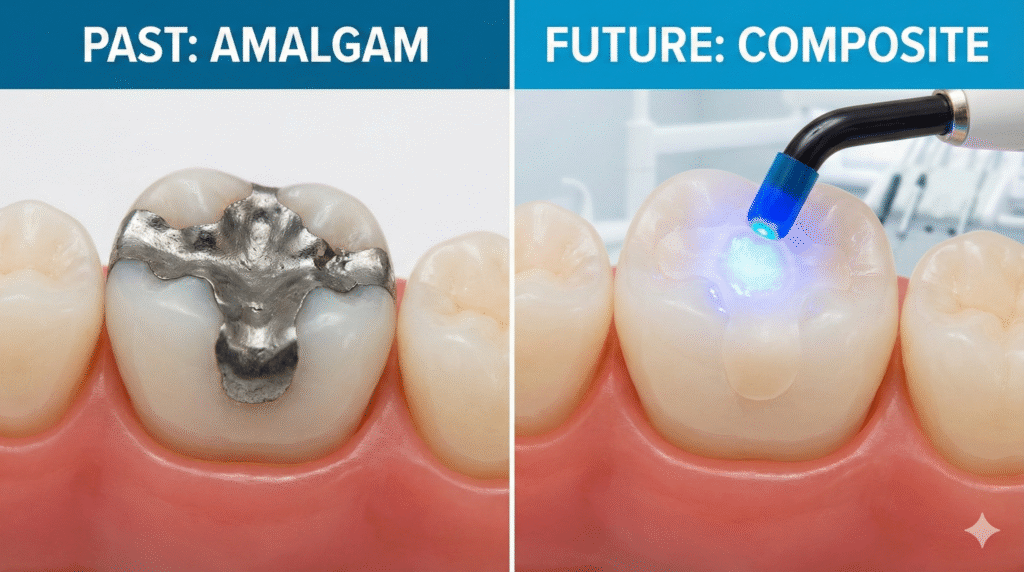
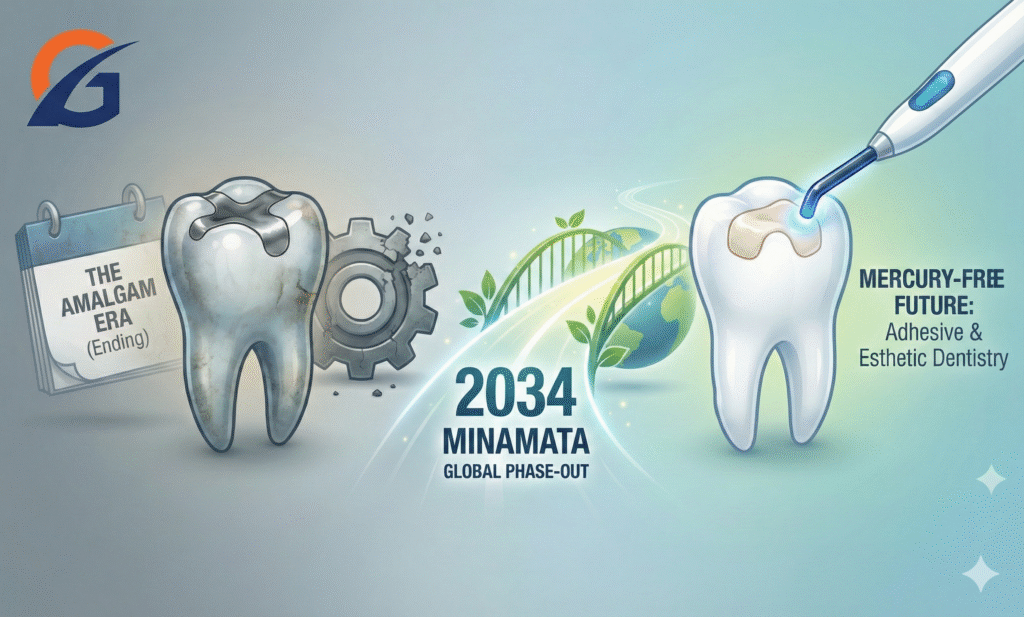
Dentistry is entering one of its most significant transitions in decades, and this shift directly affects how practices code, bill, and manage revenue. After nearly two centuries of relying on amalgam as the durable, low-cost restorative standard, the global community is retiring it. Under the Minamata Convention, mercury-containing amalgam will be phased out by 2034—closing the chapter on a material that shaped clinical efficiency, public oral health, and the financial workflows of everyday practice. This phase-out marks a defining moment for how we view amalgam in dentistry today.
Amalgam earned its place in dentistry. It was strong, moisture-tolerant, inexpensive, and predictable. It kept community clinics operating efficiently and allowed private practices to complete large restorations quickly. The phase-out is not the result of new clinical concerns. It is a response to mercury’s environmental impact. Even minor releases affect ecosystems and neurological development. Disposal pathways—from waste systems to cremation—contribute to global mercury levels. Regulators determined that reducing mercury pollution requires eliminating one of its largest intentional uses, further shifting perceptions of amalgam in dentistry.
Europe ended the use and export of amalgam in 2025, and COP-6 extended the mandate globally. By 2034, no signatory country may manufacture, import, or export amalgam. Clinicians may still place remaining stock when medically necessary—an acknowledgement that adhesive dentistry, while excellent, is technique-sensitive. Not every patient sits still. Not every tooth isolates ideally. Not every operatory has perfect conditions. These realities highlight how the end of amalgam in dentistry will require workflow adjustments across various practice settings.
This shift brings operational and financial implications for practices. Modern restorative materials—composites, glass ionomers, ceramics, and hybrids—offer superior bonding, conservation of tooth structure, and esthetics. The trade-off is increased time, higher material cost, stricter technique requirements, and more complex billing patterns. Countries that already eliminated amalgam report predictable outcomes: higher per-tooth expenditure, changes in clinical workflow, and a need for updated insurance coding and documentation due to the complexity of adhesive restorations. As amalgam in dentistry phases out, practices must prepare for these financial and coding changes.
goodbye Amalgam: Preparing Your Practice for Dentistry’s Biggest Transition in Decades
Environmentally, the benefits are undeniable. Mercury release drops sharply when amalgam leaves supply chains and waste systems. Practices no longer require amalgam separators or monitoring protocols. Nations can measure real reductions in emissions. Dentistry’s environmental footprint becomes substantially lighter, reinforcing why amalgam in dentistry is being retired on a global scale.
Beneath the surface, the deeper change is educational and structural. Dental schools are now training almost entirely in adhesive dentistry. Prevention rises in importance because every restoration requires more chair time and precision. Public clinics and high-volume practices will need support to prevent widening disparities. Regions with limited infrastructure will require training and equipment upgrades so the global phase-out does not burden the very populations meant to be protected.
Amalgam in dentistry— Article by Guardian dental Billing LLC
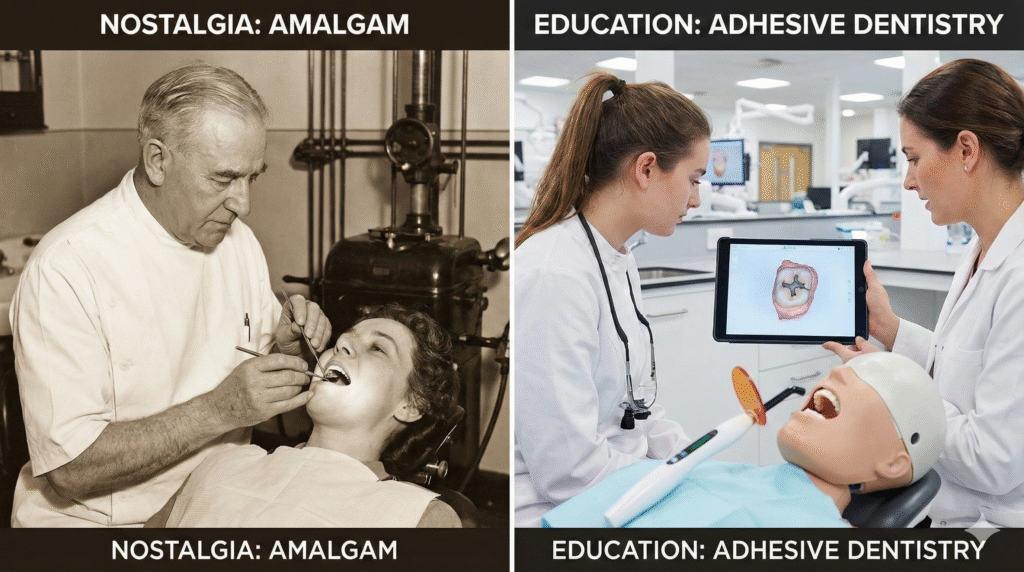
There is also a nostalgic element. Amalgam restored billions of teeth and shaped the clinical identity of generations of providers. Retiring it feels like letting go of a familiar language within dentistry. Yet the industry continues its steady move toward minimally invasive care, esthetics, and adhesive science. Materials will keep advancing, and workflows will adapt—as they always have.
This global shift is not a judgment against amalgam; it is a decision about mercury. The coming decade will test how effectively dentistry—and the billing systems that support it—balance environmental responsibility with clinical demands in a world where the fastest and most economical restoration no longer exists.
As dentistry moves deeper into this post-amalgam era, the pressure on practices will evolve in several directions. Clinical teams must adapt not only to new materials but to an entirely new rhythm of restorative care. Composite systems, glass ionomer technologies, and advanced hybrids promise better esthetics and minimally invasive outcomes, yet each introduces its own requirements for bonding protocols, isolation techniques, curing verification, and documentation. These demands lengthen chair time and raise the skill threshold—factors that directly influence scheduling, staffing, and operational cost. Practices that once relied on amalgam for high-volume restorative efficiency must now re-evaluate workflow strategies to preserve both clinical quality and financial sustainability.
Amalgam restored billions of teeth and shaped the clinical identity of generations of providers. Retiring it feels like letting go of a familiar language within dentistry. Yet the industry continues its steady move toward minimally invasive care, esthetics, and adhesive science. Materials will keep advancing, and workflows will adapt—as they always have. This global shift is not a judgment against amalgam; it is a decision about mercury. The coming decade will test how effectively dentistry—and the billing systems that support it—balance environmental responsibility with clinical demands in a world where the fastest and most economical restoration no longer exists.
Insurance carriers, meanwhile, are entering unfamiliar territory. The uniformity that once surrounded amalgam coding is giving way to a more nuanced landscape. Adhesive restorations vary widely in complexity, number of surfaces, required materials, and procedural steps. Proper coding now requires more detailed documentation, including shade selection, liner placement, isolation methods, and photographic evidence in certain cases. Payers are increasingly scrutinizing claims involving composite and ceramic restorations, not from suspicion, but from the need to establish standardized guidelines for a world without amalgam. Practices that fail to update their documentation protocols may experience delays, denials, or requests for further information—problems that never existed when amalgam dominated restorative care.
Financial managers in dental offices will also face new forecasting challenges. Material costs for modern restoratives are significantly higher, and inventory tracking becomes more complex as practices stock multiple bonding agents, composites, curing lights, and finishing systems. Budgeting for equipment upgrades—including isolation devices, curing meters, and high-quality suction systems—will become a standard part of annual planning. Practices that once viewed restorative dentistry as predictable revenue may see greater variability as material choice, case difficulty, and patient affordability intersect more sharply.
On the educational front, the profession is undergoing a generational reset. Dental schools are reducing amalgam instruction and expanding adhesive dentistry curricula. While this prepares new graduates for future expectations, it also widens the skills gap between providers trained decades apart. Continuing education will play a vital role in bridging this divide, ensuring that seasoned practitioners can confidently transition to newer systems without compromising clinical outcomes. The global phase-out may ultimately elevate the overall standard of care, but only if training remains accessible, affordable, and evidence-based.
Finally, the shift carries a broader societal implication. As restorative care becomes more time-intensive and technique-sensitive, underserved communities risk facing longer wait times or reduced access. Policymakers, dental organizations, and public health programs must proactively address these disparities by investing in workforce development, equipment modernization, and reimbursement models that reflect the real demands of adhesive dentistry.
The retirement of amalgam marks the end of an era, but it also signals the beginning of a transformative chapter—one defined by environmental responsibility, advanced materials science, and evolving financial systems. Dentistry has adapted before, and it will again. The challenge now is to navigate this transition thoughtfully, ensuring that sustainability, patient care, and economic stability remain aligned in a world forever changed by the decision to move beyond mercury.
 Skip to content