10 Powerful Dental Insurance Verification Checklist Steps for 2026
Dental Insurance Verification Checklist for 2026
Dental Insurance Verification Checklist procedures have become more important than ever in today’s dental industry. If you’ve ever submitted a claim only to discover that the patient’s insurance was inactive, benefits were exhausted, or a waiting period applied, you understand how costly verification mistakes can be.
Many dental practices focus heavily on treatment planning and patient care but underestimate the impact that proper insurance verification has on revenue. In reality, some of the most common claim denials can be prevented simply by following a thorough Dental Insurance Verification Checklist before treatment begins.
When benefits are verified correctly, dental offices experience fewer denied claims, faster reimbursements, improved patient satisfaction, and stronger cash flow. Patients also appreciate knowing their financial responsibility before treatment starts rather than receiving unexpected bills weeks later.
This guide will walk you through a practical Dental Insurance Verification Checklist that every dental practice should use in 2026.
What Is a Dental Insurance Verification Checklist?
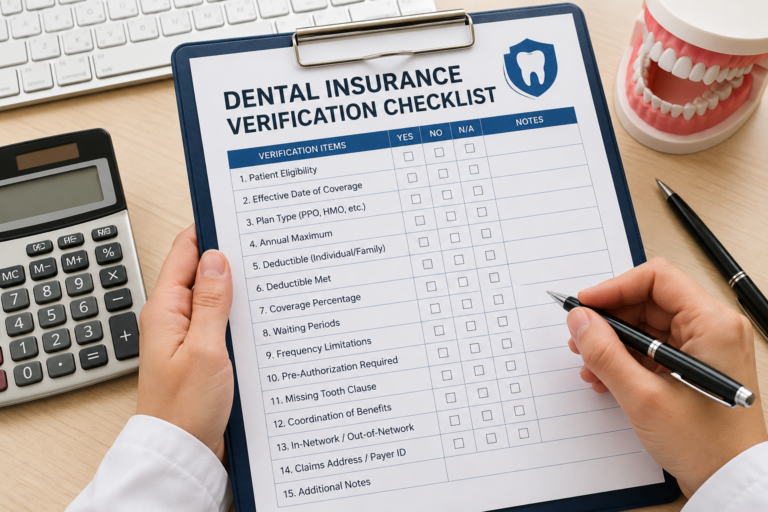
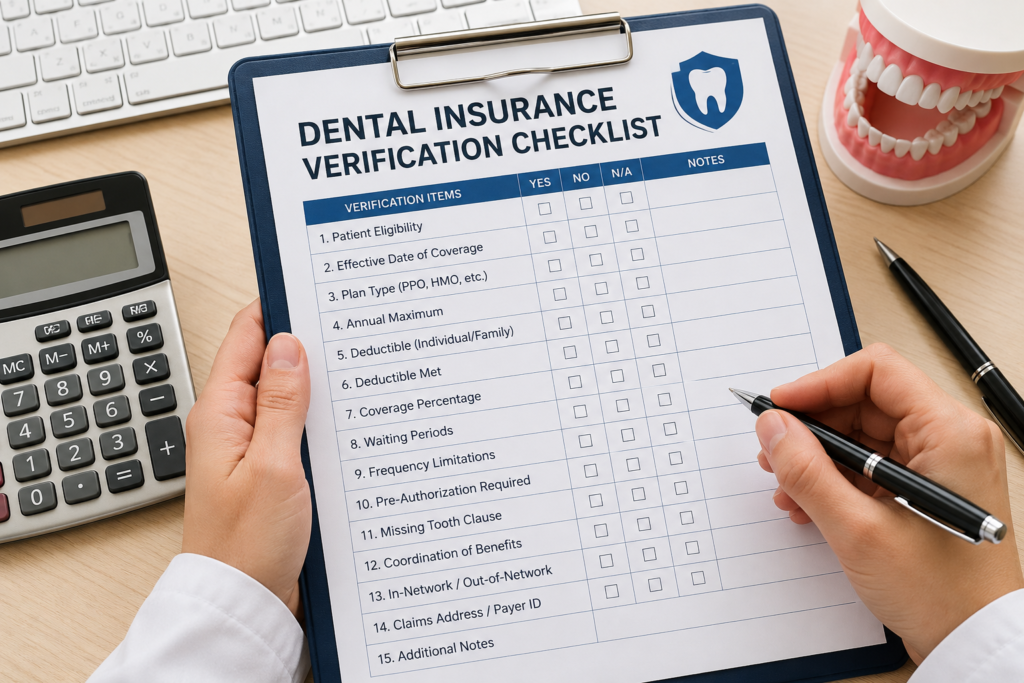
A Dental Insurance Verification Checklist is a structured process used to confirm a patient’s insurance benefits before treatment is provided.
The checklist helps dental teams verify:
- Active coverage
- Eligibility status
- Deductibles
- Annual maximums
- Coverage percentages
- Waiting periods
- Frequency limitations
- Pre-authorization requirements
- Coordination of benefits
Using a consistent Dental Insurance Verification Checklist reduces errors and helps practices collect payments more efficiently.
Why Dental Insurance Verification Matters
Insurance plans have become increasingly complex over the last several years.
Coverage rules vary between carriers, employer groups, and individual plans. Patients often assume their insurance will cover treatment simply because they have an active policy. Unfortunately, active coverage does not always mean a procedure is covered.
Without a proper Dental Insurance Verification Checklist, practices may face:
- Claim denials
- Delayed payments
- Increased accounts receivable
- Lost revenue
- Patient complaints
- Additional administrative work
The American Dental Association (ADA) provides educational resources that help dental professionals better understand insurance and practice management trends.
Step 1: Verify Patient Eligibility
The first step in any Dental Insurance Verification Checklist is confirming that the patient’s policy is active.
Always verify:
- Coverage status
- Effective date
- Termination date
- Plan type
Even returning patients may experience insurance changes during the year.
Step 2: Confirm Subscriber Information
Incorrect subscriber information is a common cause of claim rejections.
Review:
- Subscriber name
- Date of birth
- Member ID
- Group number
- Employer information
Small data entry mistakes can create major billing problems.
Step 3: Check Annual Maximum Benefits
Most dental insurance plans include annual maximum benefit limits.
Verify:
- Annual maximum amount
- Benefits already used
- Remaining balance
Understanding remaining benefits allows your office to provide accurate treatment estimates.
Step 4: Review Deductibles
Deductibles directly impact patient responsibility.
Confirm:
- Individual deductible
- Family deductible
- Remaining deductible balance
Patients appreciate transparency regarding their expected out-of-pocket costs.
Step 5: Verify Coverage Percentages
Not all procedures are covered equally.
Review coverage levels for:
- Preventive services
- Basic procedures
- Major procedures
- Endodontics
- Periodontics
- Prosthodontics
- Oral surgery
Never assume percentages based on previous plans.
Step 6: Check Waiting Periods
Waiting periods are among the leading causes of denied dental claims.
Verify whether waiting periods apply to:
- Crowns
- Bridges
- Root canals
- Implants
- Orthodontics
Identifying waiting periods before treatment helps avoid reimbursement surprises.
Step 7: Review Frequency Limitations
Many plans limit how often certain services are covered.
Examples include:
- Exams every six months
- Bitewing X-rays annually
- Full mouth series every three to five years
- Periodontal maintenance restrictions
These limitations should always be reviewed during the Dental Insurance Verification Checklist process.
Step 8: Verify Pre-Authorization Requirements
Certain procedures may require prior authorization.
Common procedures include:
- Implants
- Crowns
- Bridges
- Orthodontic treatment
- Periodontal surgery
Obtaining authorization in advance can improve reimbursement success.
Step 9: Confirm Coordination of Benefits
Patients may have more than one insurance policy.
Verify:
- Primary insurance
- Secondary insurance
- Filing order
- Coordination requirements
Incorrect coordination of benefits information can delay payment significantly.
Step 10: Document Everything
A complete Dental Insurance Verification Checklist should always include documentation.
Record:
- Verification date
- Insurance representative name
- Reference number
- Benefits discussed
- Coverage limitations
- Notes and comments
Good documentation helps support claim appeals when necessary.
Common Insurance Verification Mistakes
Even experienced offices make mistakes.
Common errors include:
Only Checking Eligibility
Eligibility does not guarantee coverage.
Ignoring Annual Maximums
Patients may have little or no benefits remaining.
Missing Waiting Periods
Waiting periods frequently result in denied claims.
Poor Documentation
Insufficient records can make appeals difficult.
Not Verifying Every Visit
Coverage can change at any time.
Benefits of Outsourcing Insurance Verification
Many practices choose to outsource their Dental Insurance Verification Checklist process.
Benefits include:
- Reduced workload
- Improved claim accuracy
- Faster verification turnaround
- Lower denial rates
- Better staff productivity
- Improved cash flow
Professional dental billing teams can often identify coverage issues before they impact revenue.
How Guardian Dental Billing Helps
At Guardian Dental Billing, we understand that accurate insurance verification is the foundation of successful dental billing.
Our team helps practices:
- Verify patient eligibility
- Review deductibles and annual maximums
- Confirm coverage percentages
- Check waiting periods
- Verify frequency limitations
- Reduce claim denials
- Improve reimbursement rates
By following a proven Dental Insurance Verification Checklist, we help dental practices strengthen their revenue cycle and focus more on patient care.
For additional industry guidance, dental professionals can review resources available through the American Dental Association (ADA) and the Centers for Medicare & Medicaid Services (CMS).
Final Thoughts
A reliable Dental Insurance Verification Checklist is one of the simplest ways to protect your practice from preventable revenue loss.
Insurance verification is not just a front-desk responsibility. It is a critical financial process that affects claim approval, reimbursement speed, patient satisfaction, and overall practice profitability.
By consistently following a detailed Dental Insurance Verification Checklist, dental practices can reduce billing errors, improve collections, and create a better experience for both patients and staff.
Dental practices should also stay informed about industry regulations and payer requirements through resources provided by the Centers for Medicare & Medicaid Services (CMS).
As insurance requirements continue to evolve in 2026, practices that prioritize accurate verification will be better positioned for long-term success.
Frequently Asked Questions
What is a Dental Insurance Verification Checklist?
A Dental Insurance Verification Checklist is a step-by-step process used to confirm insurance eligibility, benefits, limitations, deductibles, and coverage details before treatment begins.
Why is dental insurance verification important?
Proper verification helps reduce claim denials, improve collections, and provide accurate financial information to patients.
How often should insurance be verified?
Insurance benefits should ideally be verified before every patient appointment.
Can insurance verification reduce claim denials?
Yes. Accurate verification identifies coverage issues before treatment, helping prevent many common claim denials.
Should dental practices outsource insurance verification?
Many practices outsource verification to improve efficiency, reduce administrative burdens, and increase claim accuracy.